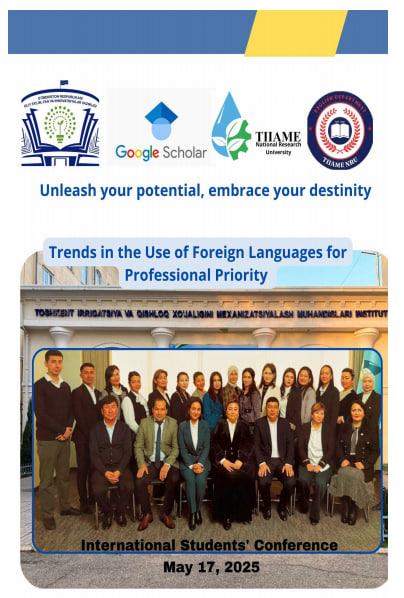
LANGUAGE SKILLS FOR PROFESSIONAL DEVELOPMENT IN AGRICULTURE
https://doi.org/10.5281/zenodo.15667205
Keywords:
Agricultural education, language skills, professional development, English for Specific Purposes (ESP), global agriculture, communication, international cooperation, rural development, language training, sustainable agricultureAbstract
In today's rapidly evolving agricultural landscape, language skills have
become increasingly vital for professional development. Agriculture is no longer a
locally confined sector; it is deeply connected to global markets, international
research collaborations, cross-border training programs, and advanced technologies
originating from various parts of the world. In light of global challenges such as
climate change, food insecurity, and sustainable development, access to up-to-date
knowledge and international discourse is crucial. Consequently, proficiency in
foreign languages—especially English—plays a crucial role in enabling agricultural
professionals to access international knowledge resources, apply modern farming
techniques, and participate in global discussions on sustainability, innovation, and
food security.
This study investigates the significance of foreign language proficiency in the
agricultural sector by analyzing both qualitative and quantitative data collected from
agricultural students, researchers, and field practitioners in Uzbekistan. The research
methodology included structured questionnaires, semi-structured interviews, and
literature analysis to identify how language skills influence academic success, job
opportunities, and access to international development programs. The results indicate
that individuals with higher levels of language competence are more likely to benefit
from international internships, scholarship opportunities, global partnerships, and up
to-date technical manuals and scientific literature
References
.Crystal, D. (2003). English as a global language (2nd ed.). Cambridge University
Press
.Graddol, D. (2006). English next: Why global English may mean the end of
'English as a Foreign Language'. British Council. 3.Hutchinson, T., & Waters, A. (1987). English for Specific Purposes: A learning- centred approach. Cambridge University Press. 4.Kassim, H., & Ali, F. (2010). English communicative events and skills needed at
the workplace: Feedback from the industry. English for Specific Purposes, 29(3), 168–182. https://doi.org/10.1016/j.esp.2009.10.002
Ramos, R. A., & Pavón, V. (2021). The role of English in agriculture and rural
development: A content and language integrated approach. International Journal of
Applied Linguistics, 31(2), 195–212. https://doi.org/10.1111/ijal.12345
Sadeghi, K., & Richards, J. C. (2016). ESP and needs analysis: An Iranian case
study. Journal of English for Academic Purposes, 21, 1–11. https://doi.org/10.1016/j.jeap.2015.11.003
Tzotzou, M. (2014). Designing and implementing ESP courses: A case study in
the Greek context. Procedia - Social and Behavioral Sciences, 116, 3449–3454. https://doi.org/10.1016/j.sbspro.2014.01.782
UN FAO. (2020). The role of education and training in achieving agricultural
development goals. Food and Agriculture Organization of the United Nations. http://www.fao.org/education-agriculture